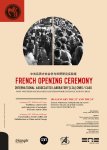
Colloques d’ouverture du Laboratoire International Associé LIA (CNRS/CASS) : « Sociologies post-occidentales et Sciences de terrain en Chine et en France »
23 janvier 2014 LIA French Opening Ceremony (CNRS/CASS) : « Post-Western Sociologies and Fieldwork in France and in China », A l’ENS de Lyon, en salle de conférence de l’IFE (Site Ferdinand Buisson), 19 allée de Fontenay, Lyon 7eme
Colloques / Conferences
Cette cérémonie d’ouverture du LIA Laboratoire Sociologies post-occidentales et Sciences de terrain en Chine et en France fait suite à la cérémonie d’ouverture chinoise qui a eu lieu à Pekin le 9 novembre 2013. Elle se déroulera sur 2 jours à l’ENS de Lyon, sous la forme de 2 colloques internationaux.
- 23 janvier 2014 / 2014 January 23th : Traditions, controverses et trajectoires des sociologies française et chinoise (partie 2) / Traditions, controversies and trajectories of sociologies in France and in China (2)
- 24 janvier 2014 / 2014 January 24th : Incertitudes, conflit social et mobilisations en France et en Chine / Uncertainties, Social Conflict and Mobilizations in China and in Europe
Organisateurs / Organizers
- Triangle, CNRS, ENS de Lyon
- Institute of Sociology, CASS, with Shanghai University, Peking University and Nanjing University
Inscriptions / Registration
Présentation / Presentation
The International Research Laboratory (LIA) CNRS-CASS “Post-Western Sociology and Fieldwork in China and France”, established in 2013, is the result of a very dynamic and excellent scientific cooperation between CNRS and Institute of Sociology, Chinese Academy of Social Sciences (CASS). The aim of the LIA is to contribute to analysis of the ways in which sociological knowledge is produced and deployed over time in China and France. The intellectual engagement results from a very intensive program of cooperation between Chinese sociologists and French sociologists since 2006.
Institute of Sociology, Chinese Academy of Social Sciences (CASS) and Triangle “Action, Discourses, Political and Economic Thought” CNRS are supporting the LIA. Professor Li Peilin, Vice-President of Chinese Academy of Social Sciences (CASS), and Professor Laurence Roulleau-Berger, Research Director at CNRS, ENS Lyon, are co-Directors of the LIA.
The department of sociology of Peking University, the department of sociology of Nanking University, and the department of sociology of Shanghai University are LIA’s partners and signatory institutions.
We thought that a comparative approach to the ways in which paradigms and theoretical methodologies are put into practice in France and China, taking as a starting point clearly defined research situations, would lead to the production of new sociological knowledge. The aim of this LIA is to contribute to analysis of the ways in which academic knowledge is produced and deployed over time. Taking as its starting point sociological research over the past 30 years and, more specifically, a comparison of academic trajectories and research practices between France and China, the program aims to produce, on the basis of Chinese and French sociology, a common and conceptual space.
Our central hypothesis is
The processes by which sociological knowledge is produced in France and China vary in academic trajectory, posture and theoretical methodologies, which define specific spaces and shared spaces on the basis of research practices. As sociology becomes internationalised, the specific spaces and the shared spaces come into being on the basis of situated intellectual traditions, exchanges, borrowings and the appropriation of produced and inherited knowledge as well through the rejection, effacement or re-exporting of sociological knowledge that sometimes appears to be universal and sometimes becomes specific. Specific spaces and shared spaces in France and in China are producing Post-Western sociology and transnational knowledge.
The LIA aims to reveal the dynamics of knowledge exchange, evaluation and hybridization that have developed beyond the hegemonic Western models, disrupting and challenging them. This approach will enable us to identify the points at which sociology constructed in France and those produced in China meet, overlap and cross-fertilize each other. The challenge that has developed over the past 20 years is a major one, revolving as it does around the question of the international visibility of non-Western knowledge in order to make progress in the production of new knowledge about local societies and the global society. As knowledge circulates and becomes globalised, new centres and new peripheries are formed, giving rise in turn to new hierarchies that emerge discreetly and in which rivals compete to develop innovative knowledge.
In our LIA‘s program we have defined five themes :
- Traditions, controversies and trajectories of sociology in France and China
- Issues around designation and categorization in sociology
- Societies narratives, individuation and biography
- Contexts, situations and cross-cultural perspectives
- Academic knowledge and common knowledge
The Chinese LIA’s Opening Ceremony at CASS, Beijing, in 2013 on November the 9 and the 10th was opened with two conferences :
- on november the 9 with Traditions, controversies and trajectories of sociology in France and China (part 1)
- on november the 10 with we have developed a cross-cultural perspectives on the topic of Cities, risks and disasters : new experiences in China and France (theme 4)
The French LIA’s Opening Ceremony at CASS, Lyon in 2014 on January the 23 and the 24 will be opened with two conferences :
- on January the 23 with Traditions, controversies and trajectories of sociology in France and China (part 2)
- on January the 24 with Uncertainties, Social Conflict and Mobilizations in China and in Europe
Programme / Program
2014 January 23rd : Traditions, controversies and trajectories of sociologies in France and in China (2)
Voir la présentation de la 1ère partie de ce colloque, qui a eu lien le 9 novembre à Pekin / Part 1 took place in China on November, the 9th.
- 9h-9h30 : Speeches of
-
- Pascal Marty, INSHS/CNRS, Directeur-Scientifique Adjoint Europe et International
- Jacques Samarut, ENS Lyon President,
- Chen Guangjin, Director of the Institute of Sociology, CASS (Peking)
- Renaud Payre, Director of Triangle
- 9h30-9h45 : Introduction by Laurence Roulleau-Berger, Research Director at CNRS Triangle
Discussant : Michel Kokoreff, Professeur à l’Université Paris 8, Directeur de GTM
- 9h45-10h15 : Laurence Roulleau-Berger, Research Director at CNRS, Triangle, ENS de Lyon : Post-Western Sociologies and Methodological Cosmopolitism
- 10h15-10h45: : Xie Lizhong, Professor and Dean of the Department of Sociology, Peking University : Post-Sociology and Classical Sociology : Ruptures and Continuities
- 10h45- 11h15 : discussion
Discussant : Stéphane Dufoix, Assistant Professor HDR, Nanterre University, Director of Sophiapol, HDR à l’Université de Nanterre
- 11h15- 11h45 : Shen Yuan, Professor of sociology, Dean of the department of Socioloy, Tsinghua University : Chinese Public Sociology
- 11h45-12h15 : Luc Boltanski, Research Director at EHESS, Emeritus, Paris : Critical Sociology and Sociology of Critic
- 12h15-13h : Discussion
13h-14h30 : lunch
Discussant : Frédéric Le Marcis, Professor of Anthropology, ENS Lyon, Triangle
- 14h30-15h : Chen Guangjin, Professor of sociology, Director of Institute of Sociology, CASS : Chinese society- Change and transformation
- 15h-15h30 : Ahmed Boubeker, Professor of Sociology, Saint-Etienne University, Max Weber Center : Post-Colonial Ruptures and new boundaries of French society
- 15h30- 16h15 : discussion
16h15-16h30 : break
Discussant : Christine Détrez, Associate Professor in Sociology, HDR, ENS Lyon, Centre Max Weber
- 16h30-17h : Zhou Xiaohong, Professor in sociology and social psychology, Dean of the School of Social and Behavioral Sciences, Nanjing University : Chinese Feeling : Social Mentality in a Transformation Society
- 17H-17h-h30 : Bernard Lahire, Professor of Sociology, ENS, Max Weber Center : Social differenciation and dispositional plurality
- 17h30-18h15 : General discussion
2014 January 24th : Uncertainties, Social Conflict and Mobilizations in China and in Europe
Presentation
According to Beck European societies have entered a second phase of modernity characterised by the need to face up simultanously to processes of individualisation, underemployment and environmental and financial risks at a global level. However, this second phase of modernity cannot be considered without also taking account of the various forms of modernity in other parts of the world. From this point of view, the second phase of modernity can be considered only in conjunction with the modernity of other societies, such as Chinese society.
While conflicts are emerging between different orders of recognition in European and Chinese societies, at the same time spaces of social recomposition are emerging in which individual and collective identities are being reconstructed in contexts of strain and tension. We can say that the processes of domination that have been extensively investigated in European sociology area now being investigated in Chinese sociology at a number of different levels. Thus the apparatuses of domination may be described as instituteed and reticular and as dispersed and multi-sited. The multiple modernities also contain forms of sub- jectivity situated in different societal spaces. Processes of individuation are very pronounced in European societies and emerging in China ; in both societies, individus are facing situations characterised by inequalities and paradoxical injunctions, which are produced by radically dif- ferent political and economic histories. They are confronted by double-bind situations generated by different societies, also become actors in order to manage their ‘blurred’ identities and become involved in processes of social reconstruction. Capabilities influence the ways in which these stocks of resources are reconstructed and the forms that reconstruction takes.
In Western Europe, for example, individuals are increasingly constructing their identities around a multiplicity of roles and affiliations linked to a diverse range of socialisation spaces. However, hierarchies of inequalities have proliferated and the forms of access to government of self have become increasingly differentiated. Strong tensions between differentiation and social integration run through Chinese society, reflecting a mode of entry into a form of modernity linked to the market economy. A capitalist order that sets those best endowed with social, economic and cultural resources against those least well endowed with such resources has been super- imposed on top of a socialist order. The ‘class struggle’ and the ‘struggle for position’ have become jumbled together rather than succeeding one another, as they would have done in Western Europe. Against this background, a process of individuation has become established in Chinese society through the weakening of collective structures and the declared egalitarianism of socialist ideology, leading to ever increasing inequalities ; and while affirmation of the process of individuation also means freedom of choice and increased risk, subjectivity does not yet appear to be a collective issue in Chinese society, although it is gradually emerging.Retour ligne automatique
Some of the individuals who experience the moral ordeal of contempt and are thus refused certain forms of social recognition develop forms of collective resistance. They bring to light a social struggle that takes the form of a practical process in the course of which individual experiences of ‘dis- tancing’ and contempt are collectively reinterpreted. Situations in which entire populations are ‘distanced’ may in turn give rise to conflicts, social movements and riots. However, while they may regen- erate social affiliations, they may also produce new forms of social exclusion.
- 9h-9h15 : Introduction by Laurence Roulleau-Berger : Uncertainties, social conflict and mobilizations in China and in France
Session 1 : Multiples Inequalities and Action in Uncertain Contexts
Discussants : by Xie Lizhong, Professor and Dean of the Department of Sociology, Peking University
- 9h15-9h45 : François Dubet, Professor at Bordeaux II University, Director of Studies in the School of High Studies on Social Sciences (EHESS) : Dominations, Injustices and Action
- 9h45-10h15 : Yang Yiyin, Professor and Director of the department of social Psychology, Institute of Sociology, CASS : Risk, confiance’s crisis and individuation in China
10h45-11h : break
Session 2 : Cities, tensions and urban recomposition
Discussants : Zhou Xiaohong, Professor in sociology and social psychology, Dean of the School of Social and Behavioral Sciences, Nanjing University and Samuel Lézé, Associate Professor of Social anthropology, ENS Lyon, Deputee Director of the human sciences department
- 11h-11h30 : Liu Yuzhao, Professor of Sociology Shanghai University
School of Sociology and Political Science : Migrants and segregation in Chinese Cities - 11h30-12h : Agnès Deboulet, Professor of Sociology, University Paris 8 : Global cities, inequalities and urban democracy
- 12h-12h30 : Samadia Sadouni, Associate Professor of Sociology and Political Science : Uncertainties and Muslim Solidarity in Johannesburg
- 12h30-13h : Discussion
13h-14h30 : lunch
Session 3 : Work, inequalities and mobilizations
Introduction and discussion by Chen Guangjin, Professor of sociology, Director of Institute of Sociology, CASS
- 14h30-15h : Liu Neng, Professor of Sociology, Department of Sociology, Peking University : Workers, inequalities and collective action in China
- 15h-15h30 : Djaouida Séhili, Associate Professor of sociology, University Lyon 2 : Gender and ethnic discriminations on labor markets
- 15h30-16h : Sophie Béroud, Associate Professor of Sociology and Political Science, University Lyon 2 : Workers, conflicts and mobilizations in Europe
- 16h-16h30 : discussion
16h30-16h45 : break
- 16h45-18h : Conclusion : About LIA’s scientific perspectives
by Laurence Roulleau-Berger, Chen Guangjin, Shen Yuan and Zhou Xiaohong
