Accueil

English overview


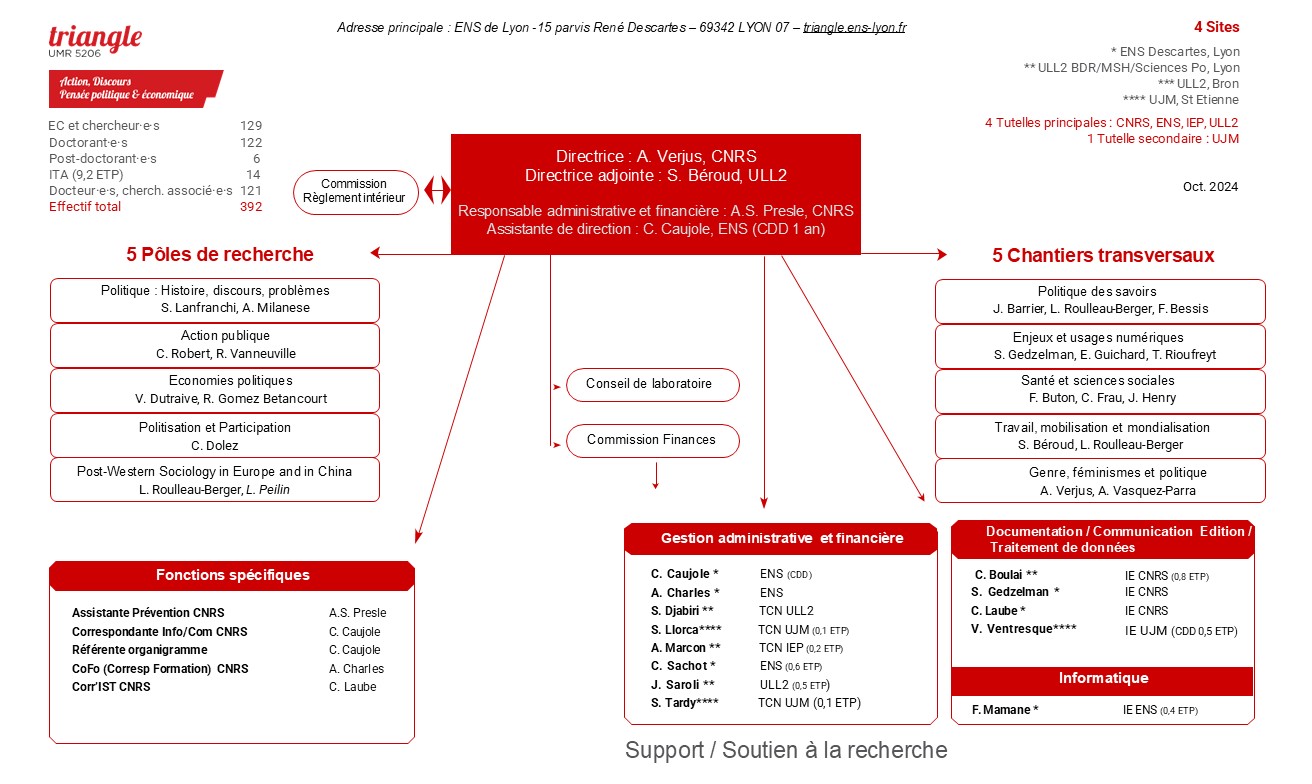
The UMR 5206 "Triangle. Action, discourses, economic and political thought" is a pluridisciplinary joint research unit of ENS de Lyon, Université de Lyon2, IEP de Lyon, Université Jean Monnet Saint-Etienne and the CNRS (National Center for Scientific Research - INSHS).

Contacts :


Director : Jean-Claude Zancarini
Administrative contacts

Members :


88 researchers (78 academic teachers and 10 CNRS researchers [Contacts & CVs]
9 associated teachers [Contacts & CVs]
115 doctoral students in 2011 [Contacts & CVs]
The way the unit is managed, along principles established by the Conseil de laboratoire, fosters research initiatives at all levels : specialized hubs, collectives and individual projects, informal and transversal groups (groups in which new thematics can more easily grow), strong support to doctoral students, and to documentary and (traditional and online) publishing policies. In that respect, our administrative staff (ITA) play a major role in the unit’s life.

Publications :


Triangle is committed to creating open archives by collecting its research teams’ scholarly publications in the HAL SHS - TRIANGLE Open Archive
Books and articles ... published in
2012,
2011, 2010, 2009...
Browse by year, or by authors
Pre-formated list of Triangle publications 2010-2012 (by document type)

Scientific identity and organization


Disciplines : political science, political philosophy, history of political thought and economic thought, gender studies
Linguistic areas : France, Italy, Russia, Arabic world, Great Britain, USA, Central America.
UMR 5206 Triangle was created in 2005 following the idea that this pluridisciplinary choice could lead to something better than a pure addition of competencies and contribute to a fuller understanding of political thought and action. The last four years have proved the productive accuracy of this hypothesis.
The unit is structured around six specialized hubs :

Our teams :

Public action


Contacts : Gilles Pollet and Renaud Payre
This hub brings together all Triangle’s works and activities that focus on the analysis of policies and public action, defined as theoretical and empirical governmental devices. Situating our research completely in social sciences, our approach is close to the perspective of the neo-institutionalists, since we also try to integrate the intersections between ideas, actors, institutions, and interests.
The specialized hub of ’Public action’ is developed around three main axes.
In the first axe, "Knowledge for government" , we mainly study the constitution and mobilizing of knowledge in administrative action, as well as the diffusion (the transatlantic flow particularly) of knowledge directly used for governing and administering societies. This research, which enquires into the interactions between administration, policies and politics, is developed from a socio-historical perspective.
The second axe, "Social transformation, territorialisation and contemporary governance", is where interactions between social transformations and contemporary governance are studied, and where the task research of members involves work focusing on the complex process of the territorialisation of public action and governance. Some members concentrate rather on new forms of governance and democracy, while others focus more on cities, applying a comparative perspective to the study of urban policies and projects.
The third axe "Crisis and Risk Policy" using the examination of ’risk management’ devices as a start-point, considers forms of cooperation and compromise between actors, with the hypothesis that certain mechanisms can facilitate exchanges, compromises, and cooperation.
1st axe : Knowledge for government
2nd axe : Social transformation, territorialisation and contemporary governance
3rd axe : Crisis and risk policy

Politization and participation


Contacts : Sophie Béroud and Nathalie Dompnier
This hub is a Lyon 2 University team involving 25 teachers, researchers and doctoral students, whose works focus on the analysis of the interaction between society and politics, and of the socializing, committment and mobilization processes.
Our activities examine the contemporary forms of politization and of participation, bringing together fields and survey methods. The project revolves around the way values and political conceptions which are behind political action develop, and also on the political socialization processes, studied through different temporalities, in participation and mobilization practices.
We are especially asking how the valorization of participative democracy and its implied imperative of ’participation’ are contributing to the modification of political concepts and practices ; as well as the way in which voluntary, political, or trade-union organizations operate.
Enquiry into politization and participation is developed within our research seminar. The seminar also maintains a watch on current events in France, the UK, the USA, and several South-American countries, using a comparative approach.
The curriculum in « Political sociology » (from Lyon 2 University) and the Master « Political sociology » (from IEP / Univ. Lyon 2) are both closely linked to our research activities.
1st axe : Changes in political participation
2nd axe : Issues of representation
Transversal seminary : Conceptualizing political participation

Economic and political philosophy


Contacts : Michel Senellart and Ludovic Frobert
This hub is structured around three complementary axes : a "Political philosophy" axe, which is the continuation of thematics developed since 2005 (Conceptualizing war ; Foucault and governmentality, Art of governing traditions ; New radicalisms in philosophy) and two new axes : "Political economy" and "Theoretical configurations of justice and philosophy of social sciences".
In these three axes, we will explore the frontiers between political philosophy and other types of thought -which have a distanced, opposed or critical relationship to philosophy- : treatises on good government or anarchist theories (1st axe), institutionalists in economy (2nd axe), discourses in social sciences, in particular issues related to justice (international justice, justice theories from a gender study perspective) (3rd axe).
These fields of research have their own dynamics which lead naturally to their interlinking and mutual reinforcement, in such a way as to allow the appearance of new common areas of problemisation.
1st axe : Political philosophy
2nd axe : Economic philosophy
3rd axe : Theoretical configurations of justice and philosophy of social sciences

History of economic thought


Contacts : Jean-Pierre Potier and Nicolas Chaigneau
This hub has, until now, mostly concentrated on French speaking authors. The programme of editing and of establishing reference texts was developed around the works of major 19th Century authors, such as Auguste and Léon Walras, Jean-Baptiste Say and Jules Dupuit. Taking advantage of Triangle’s development of new approaches to the History of Thought and Political Philosophy, we have also focused our analyses on concepts : the flow of concepts from thought to action, and from action to thought.
Future work will continue in two directions. Analytic research will be extended to include late 19th Century British economists inspired by utilitarianism (W.S. Jevons and F. Y. Edgeworth), as well as the works of Irving Fisher, and the study of hybrid forms of liberalism and socialism developed by Republican authors in France in the 19th Century since 1830-1848. Elsewhere, the 2007-2010 international economic crisis has reactivated issues which already led to animated economic and political debate in the late 19th Century, the 1930’s and the 1970’s.
Research in our hub is structured around three axes (two thematic and one transversal).
1st axe : Market, economic competition, liberalisms and socialisms
2nd axe : Growth and crises in French and English economic
analysis (19th and 20th century)

Transversal axe : Critical editions, editing and translating methodology

Gender and politics


Contact : Anne Verjus
Gender is not a field, nor even a method. In that sense, gender studies are not essentially a discipline - in its classical sense -. The specialized hub "Gender and politics" works at another level in the way that its inquiries, and the conclusions to which they lead, push us to rethink the traditional categories used in the "disciplines".
These results tend to force us to modify the way we look at things - to change our viewpoint - and imply real upheaval in our academic habits, "habitus" and reflexes.
1st axe : Socio-historical field
A redefinition of the traditionally admitted divisions between private and political worlds, moving from the deconstruction of major figures in the public space ; from the man of the Declaration of Human Rights, to the fathers involved in masculinistic militantism committment, relating this study to an examination of conjugal practices.
2nd axe : Socio-political field
The evolving definition of socio-gendered groups, from gendered identity to sexual orientation and couples, observed particularly through the prism of violence.
3rd axe : Politico-philosophical field
Gendered methods for recognition are explored, from communication to deliberation, through the question of "practical" citizenship

Political languages and thought


Contacts : Denis Barbet and Jean-Claude Zancarini
This hub brings together linguists and specialists of the History of Thought.
Our interests are similar to those of the specialized hub "Economic and political philosophy". But where their approach to political matters is of a philosophical nature, ours is historical. Concepts are studied as being historically and geographically located, focusing on sources of thinking, which have, at some stage, in some places, constituted real laboratories and have contributed to create the first layers of modern politics, which are still found in governing processes or in the theoretical -or just discursive- legitimizations of power
1st axe : Italian laboratory
2nd axe : French laboratory
3rd axe : Liberalism in Russia in the 19th Century
4th axe : Nationalism, Islamism and world perception in the Arabic and Muslim world
5th axe : Political lexicology and lexical politology


Dernière mise à jour le 20 mars 2012.

© UMR5206 
Crédits